Chapter 10: Quality & Acceptance
Acceptance testing criteria, quality comparison standards, and commissioning checklists for wireless security deployments
Quality acceptance is the formal process of verifying that a wireless security deployment meets all design specifications, security requirements, and performance targets before handover to the operations team. A structured acceptance process prevents the handover of non-compliant installations that would require costly rework and creates documented evidence of compliance for audit purposes. This chapter defines the acceptance criteria, testing procedures, and quality standards that must be met before a deployment is considered complete.
10.1 Installation Quality Comparison
The most common quality failures in wireless security deployments are physical installation defects — incorrect AP placement, improper cable management, missing labels, and inadequate mounting. The following comparison illustrates the visual difference between a non-compliant and a compliant installation, providing a clear reference standard for quality inspectors and installation teams.
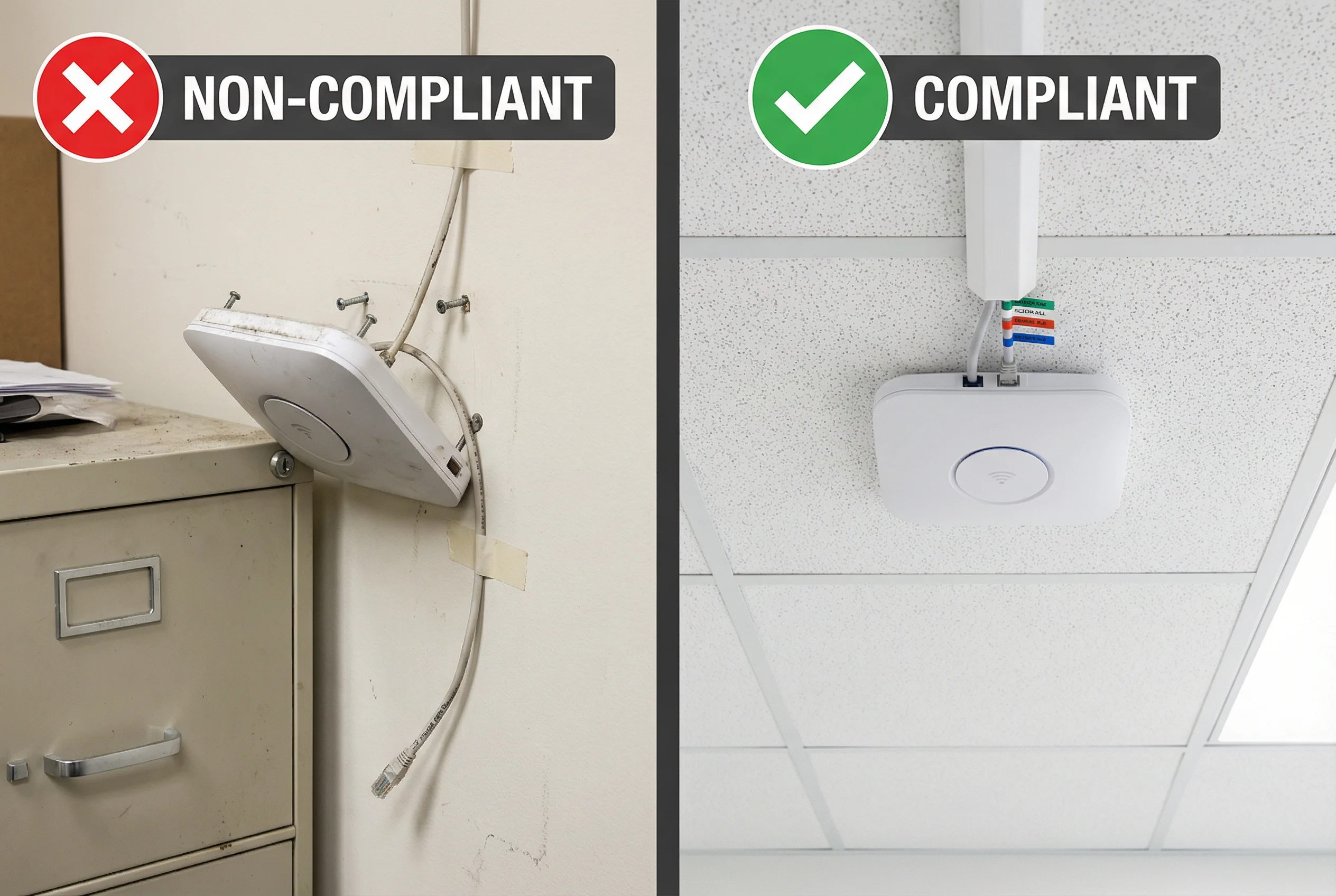
| Quality Dimension | Non-Compliant (Fail) | Compliant (Pass) |
|---|---|---|
| AP Mounting Location | Wall-mounted near floor, obstructed by furniture | Ceiling-mounted at center of coverage zone, unobstructed |
| Cable Management | Loose cable hanging without conduit or support | Cable routed through conduit, secured with ties every 300mm |
| Cable Labeling | No labels on cable or AP | Asset label on AP, cable labeled at both ends with AP ID |
| Mounting Security | Taped or loosely screwed, no tamper protection | Tamper-proof screws, security cable lock where required |
| Physical Environment | Dusty, near heat sources, inadequate clearance | Clean, ventilated, minimum 300mm clearance from obstructions |
| AP Orientation | Tilted, incorrect antenna orientation | Level, antennas oriented per manufacturer specification |
10.2 Acceptance Testing Criteria
10.2.1 RF Coverage and Signal Quality
| Test Item | Acceptance Threshold | Test Method |
|---|---|---|
| Minimum RSSI at coverage boundary | ≥ -70 dBm (data) / ≥ -67 dBm (voice/video) | Wi-Fi site survey tool, heatmap |
| Signal-to-Noise Ratio (SNR) | ≥ 25 dB at all coverage points | Spectrum analyzer + site survey |
| Channel Utilization | ≤ 50% at peak load | WLAN Controller dashboard |
| Co-channel Interference | ≤ -20 dB relative to serving AP | Spectrum analyzer |
| Coverage Overlap | 15–25% between adjacent APs | Site survey heatmap |
| Dead Zone Coverage | Zero dead zones in defined coverage area | Walk-test with site survey tool |
10.2.2 Security Configuration Verification
| Security Test | Expected Result | Test Method |
|---|---|---|
| WPA3-Enterprise SSID active | All enterprise SSIDs use WPA3-Enterprise only | Wi-Fi scanner, controller config audit |
| WPA2/WPA1/WEP SSIDs absent | No legacy security SSIDs present | Wi-Fi scanner sweep |
| PMF (802.11w) mandatory | PMF required on all enterprise SSIDs | Controller config audit |
| 802.1X authentication functional | EAP-TLS authentication succeeds with valid cert | Test client with valid certificate |
| Invalid cert rejected | Authentication fails with revoked/expired cert | Test client with revoked certificate |
| VLAN assignment correct | Client lands in correct VLAN per group membership | DHCP lease verification, VLAN tag check |
| Guest VLAN isolation | Guest clients cannot reach RFC1918 addresses | Ping test from guest VLAN |
| WIPS active | Rogue AP detection alerts generated within 60s | Deploy test rogue AP, verify alert |
10.2.3 Performance Acceptance
| Performance Test | Acceptance Threshold | Test Method |
|---|---|---|
| Authentication latency (EAP-TLS) | ≤ 2 seconds end-to-end | Timed 802.1X authentication test |
| Roaming latency (802.11r) | ≤ 150ms inter-AP roam | Roaming test with timing tool |
| Throughput per client | ≥ 10 Mbps at -67 dBm RSSI | iPerf3 throughput test |
| Controller failover time | ≤ 30 seconds AP rejoin after primary failure | Simulate controller failure, measure AP recovery |
| RADIUS failover time | ≤ 5 seconds to secondary RADIUS | Stop primary RADIUS, time new auth success |
10.3 Final Acceptance Checklist
The following checklist must be completed and signed off by both the installation team and the customer's network security team before the deployment is accepted. All items must pass before handover.